New Tech
Huawei's Energy Storage System Sets New Safety Standards With Extreme Ignition Test Success
Introduction: A Milestone in Energy Storage Safety
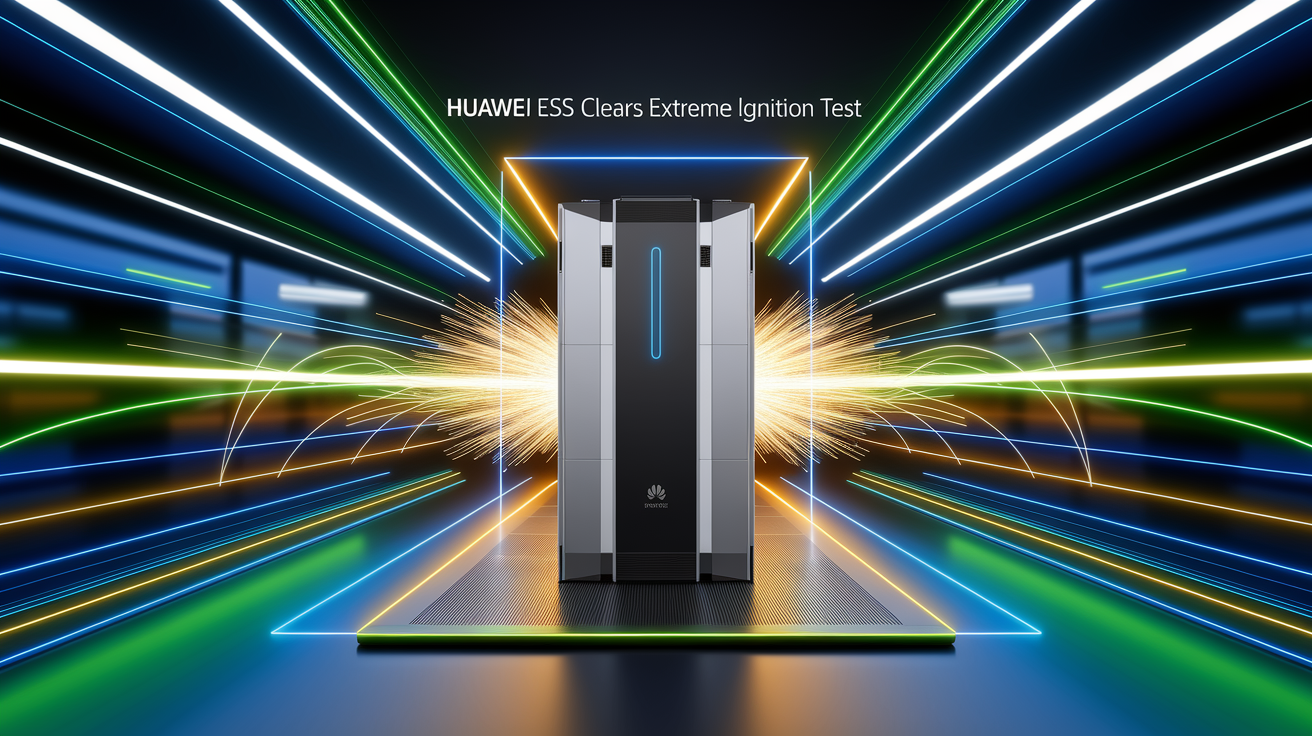
Huawei Digital Power's Commercial and Industrial Hybrid Cooling Grid Forming Energy Storage System (C&I GFM ESS) has achieved a significant milestone by successfully passing an extreme ignition test. Conducted under the scrutiny of TÜV Rheinland at a national key fire safety laboratory, this test sets a new benchmark for safety standards in energy storage systems (ESS).The Test: Pushing Safety to Its Limits
The extreme ignition test was designed to simulate the harshest conditions possible, in accordance with the UL 9540A:2025 standard. This involved inducing simultaneous thermal runaway in 60 battery cells using a pack-level overcharge method, coupled with an open-door ignition scenario. The system was tested under full charge with all fire suppression systems disabled, creating an environment that truly challenged its safety features.Impressive Performance Metrics
During the test, Huawei's energy storage system demonstrated remarkable resilience:- Peak heat release rate: 3 MW
- Temperature during fire: 961°C
- Temperature of adjacent cells: 45.3°C, well below the explosion-proof valve activation threshold
- Self-extinguishing time: Under three hours
Advanced Safety Features: Five-Level Protection Architecture
Huawei's C&I GFM ESS incorporates a sophisticated five-level protection architecture designed to mitigate the risks associated with thermal runaway. Key features include:- Inter-cell thermal isolation: Prevents propagation of heat and flames between cells.
- All-metal enclosures: Capable of withstanding temperatures exceeding 1,500°C.
- Positive-pressure oxygen-blocking design: Ensures controlled conditions during incidents.
- Fireproof labyrinth sealing: Enhances structural integrity against fire spread.
- Reinforced container fire resistance: Further limits the impact of any thermal events.
Understanding the UL 9540A:2025 Standard
The UL 9540A:2025 standard represents a significant evolution in the evaluation of energy storage systems. It focuses on real-world worst-case scenarios, emphasizing the importance of testing under conditions that could lead to thermal runaway without any suppression measures. Huawei's successful compliance with this standard marks a pioneering achievement in the ESS industry.Implications for the Energy Storage Industry
The successful completion of this extreme ignition test enhances the confidence of stakeholders in deploying energy storage systems for commercial and industrial applications. With fire safety being a growing concern in renewable energy integration, Huawei's advancements may influence future standards and insurance requirements in the industry.Competitive Positioning
Huawei's results—including delayed ignition during related tests—position the company favorably against competitors, potentially accelerating the adoption of its technologies in high-stakes environments. This success not only validates Huawei's innovative approaches but also sets a precedent that may shape the development of future energy storage systems.Conclusion: A Path Forward
As the energy storage landscape continues to evolve, Huawei's commitment to safety and innovation will play a crucial role in addressing the challenges of integrating renewable energy solutions. The successful passing of the extreme ignition test not only showcases the capabilities of Huawei's C&I GFM ESS but also reinforces the importance of stringent safety standards in the industry's growth.← Older: Equinor and Ørsted Push for Resolution Amid U.s. Offshore Wind Project
Newer: Solidion Revolutionizes Battery Performance With Innovative Silicon-Ri →
Newer: Solidion Revolutionizes Battery Performance With Innovative Silicon-Ri →
Related articles

New Tech
Revolutionizing Floating Solar: Azimuthal Trackers Enhance Efficiency in the UK
The latest research from the University of Exeter has unveiled that azimuthal trackers significantly enhance the performance of floating photovoltaic (FPV) s...
New Tech
Revolutionizing Energy Storage: LiTime Unveils High-Capacity 320 Ah LiFePO4 Battery
Introduction to LiTime's Latest Innovation In a significant leap forward for energy storage technology, LiTime , a prominent Chinese battery manufacturer, ha...

New Tech
Revolutionary Chemistry Boosts Longevity of Flow Batteries
Transforming Energy Storage with Flow Battery Innovations In a significant advancement for renewable energy technology, researchers have unveiled a breakthro...